
The Desert Dialogues: Schindler, Neutra, Frey in the Coachella Valley
Greetings, everyone. It’s been a minute since I’ve been on my site and apologies for the lack of images. They are coming! But I wanted to get this online while I get that done.
While the two Palm Springs houses designed by Richard Neutra (1892 – 1970) speak as actors on a “moonscape,” as he called it, the work of Albert Frey (1903 – 1998) and Rudolf Schindler (1887 – 1953) testify to a different relationship with the desert: not as foreigners but as compañeros.
These three restless Europeans each abandoned an exhausted Europe for America and then Southern California … and that is where the similarities stop. Their utterly different temperaments, objectives, and clients make their individual paths fascinating and well worth considering. In this short essay I hope to illuminate those journeys with a few selected projects.
Schindler
Schindler left Vienna for Chicago weeks before the Great War, which is important: he pitied, even despised, what he perceived as European Modernism’s desperate quest for order at all costs (perhaps a quite logical response to chaos and despair.) By summer 1915 he had tramped through the Grand Canyon and visited Taos and New Mexico on a rail ticket. His approximately 400 snapshots of the Southwest captured low, asymmetric pueblo masses rising from the desert floor; the intense chiaroscuro of light and dark on a late afternoon; native women and men in tribal dress.[1] He even designed a house that same year that was an obvious homage to the vocabulary of the pueblo.[2] Looking at these haunting images is to witness Schindler’s Habsburg soul meld with the earth.
Schindler’s mostly unrealized desert projects[2] were often commissioned by individuals who were free, bold, and paper-thin in resources. They sought sites in the Coachella Valley well away from public view, isolated, remote … meaning they were also dollars for the acre. Schindler designed a tiny cabin in Indio for newlyweds Paul and Betty Popenoe in 1922 with an “absolutely essential” budget of $2,000.[3] That same year he completed his own home, the Kings Road House in Los Angeles.
Our rooms will descend close to the ground and the garden will become an integral part of the house. The distinction between the indoors and the out-of-doors will disappear. The walls will be few, thin, and removable. All rooms will become part of an organic unit, instead of being small separate boxes with peepholes. . . . Our house will lose its front-and-back-door aspect. It will cease being a group of dens, some larger ones for social effect, and a few smaller ones (bedrooms) in which to herd the family. Each individual will want a private room to gain a background for his life. He will sleep in the open. A work-and-play room, together with the garden, will satisfy the group needs.[1]
In 1926, Schindler summed up his philosophy of what it means to “dwell” in strong tones that also convey his architectural strategies:[3]
Against the experimental concrete, glass, and redwood house on Kings Road, the Indio cabin was frail by comparison. The August 1922 site plan shows thick hedges framing the lot, the first defense against eyes and the notorious Valley winds. An asymmetric layout of outdoor porches, totaling about 520 square feet, roofed and with screened walls, wander around a 22’-0 x 22’-0” square shell framed in shiplap wood, implying that much of the living happened in this larger liminal space. A wood frame for growing vines frames one outdoor space.
Despite the physical difference, these two early projects also share Schindler’s radical approach to the individual. In Los Angeles, four discrete live/work studios linked by living and kitchen rooms embody an existential sovereignty for each of the four creatives. At the Popenoe, a public space with sliding screens separates “his” and “her” bedrooms, acknowledging privacy for Betty and for Paul. This central room projects above the rest of the house, recalling the influence of Schindler’s early mentor, the notorious jeremiad and radical Adolf Loos (1870 – 1933), whose concept of Raumplan reflected the hierarchy of social space: more important public/communal rooms commanded taller ceilings.[4]
One last detail, easy to overlook at first, shocks and then educates. The western side of the one outdoor room labeled “Sleeping Porch” is sheathed in vertically oriented palm fronds. They must have rustled and murmured while acting as a privacy screen and wind break, just as a “skirt” of palm fronds functions in indigenous California fan palms, Washingtonia filifera, found in the oases throughout Coachella Valley. (Within these huge skirts bustles a city, where critters and creatures abound; Palm Springers shudder when newbies shear this native feature naked.) This detail speaks eloquently to Schindler’s full-throated embrace of the desert, seeking out its native technologies, adapting them for human use.
During the next two decades, Schindler designed other projects in the Valley, including a multi-family subdivision in 1930 that included a town square around a plaza (an ancient urban typology), a central green belt, and a community garden. Under the banner of AGIC, the short-lived collaboration between Neutra and Schindler with the rather pompous title, the Architectural Group for Industry and Commerce, Schindler prepared a schematic design for an 86-acre hotel complex in Banning in September 1930.[5] Over 25 years later, the Maryon Toole House, in Palm Desert (formerly Palm Village), 1947, remains the only remaining Schindler project in the Coachella Valley.
And it is spectacular.
By contrast to the lightweight Popenoe Cabin, the “Dessert (sic) House for Miss Maryon Toole” recalls Frank Lloyd Wright’s plays on 30/60 angles and strategies but is very much Schindler’s own version of “breaking the box,” here in a way that is more lizard than house. Walls and roofs are pulled apart, reconceived as independent assemblies acting in concert. Angles converge and diverge. Low to the ground, a series of three overlapping, boomerang-shaped wood roofs shelter walls of burnished desert rocks embedded in concrete; this “spotted wall” recalls a cheetah’s skin, simultaneously visually standing out and disappearing into the landscape.[6]
ne such wall, facing west and located near the street, supports the carport roof. Slightly angled in plan to add structural stability (like Frey’s curved walls, more on that later), this wall firmly wards off views from the street while also framing the edge of a circular garden. To the east, the roofs slide out from one another and stretch out into the desert, ending in full-height walls of glass opening out to an outdoor terrace. The low-pitched wood roofs, whose gables are also glass, seem to float above the solid walls, which slightly extend beyond the roofline. “The whole is shaded by an ample but lightly poised roof reminiscent of a giant leaf… “ Schindler said of his foliated roof design.[7]
The year before, Schindler and his bride Pauline had taken a road trip through Yosemite, staying in campers’ shelters. “As Schindler describes it, Kings Road ‘… fulfils the basic requirement for a camper’s shelter: a protected back, an open front, a fireplace, and a roof…’ “[8] The description seems more fitted to the Toole than to his LA home. Protected by the last of the roofs, before Palm Desert grew up into a city, the plein air terrace must have been a magical place, an outpost to witness the miles of open, silent desert beyond on velvety nights with all the stars. Now being restored, including Schindler’s (rare) landscaping plan and plant list, the house exemplifies Schindler’s sense of romance and strong emotion in his adaptation to the desert.
Neutra
In Wie Baut Amerika (How America Builds), Neutra’s 1927 monumentally circumlocutory book intended for a German-speaking audience, endless pictures of steel skyscraper framing, metal windows, details of rivets, bolts, and new-fangled Otis elevators boast an America bristling with the future of new technologies. Towards the end of the slender volume, however, the tenor changes abruptly. Suddenly a few pictures of adobe pueblo dwellings percolate the remaining text, yet another strange American phenomenon, Neutra might have thought, sure to impress European audience.[9] Late in the book, as though an afterthought, he included plans and photos of Schindler’s 12-unit Pueblo Ribera, La Jolla, 1923, a project of redwood, sand, and concrete made from beach sand, Likewise, Lloyd Wright’s Oasis Hotel, 1924, Palm Springs, earned a photo, as did Frank Lloyd Wright’ concrete “knit-block” Storer House, Los Angeles, 1923 … all three a world away from Neutra’s obvious admiration for Chicago skyscrapers.
Completed in 1937, Neutra’s other desert project, the Grace Lewis Miller House, is much closer to the native architecture of the Southwest than the 3,800-square-foot Kaufmann villa. Apart from the obvious differences in budget, while the Miller is the Kaufmann’s opposite physically, the little house was no less successful, garnering publicity ever since. While its asymmetric, boxy off-white volumes and humble materials (such as hand-rubbed tempered Masonite wall paneling) recall the pueblo dwellings of the Southwest, it was Neutra’s synthesis of that culture with the severity of the International Style, along with a full repertoire of his trademark strategies and crisp details, that ensured the acclaim of the spirited structure.
The Miller’s very location speaks to the ambitions of its client, an East Coast urbanite determined to attract well-to-do socialites to her European exercise methods. Her two flat acres of desert scrub were a six-minute walk to the legendary Racquet Club, opened in 1934, while to the south stood the majestic El Mirador Hotel, 1928, just visible from Miller’s lounge chairs on her screened terrace on the south. Half the building connotes the “professional” side, with its own path lined with the scarlet tones of castor bean guiding a client to the front door. This half is mostly solid and opaque except for the north wall. Here large panels of translucent glass, surmounted by operable clear clerestory windows, provide ample north light for the exercise studio, utterly private because of the translucency. By contrast, the southern, “domestic” section is open and porous, with its luminous reflecting pool and deep overhang that provided a microclimate for the terrace.
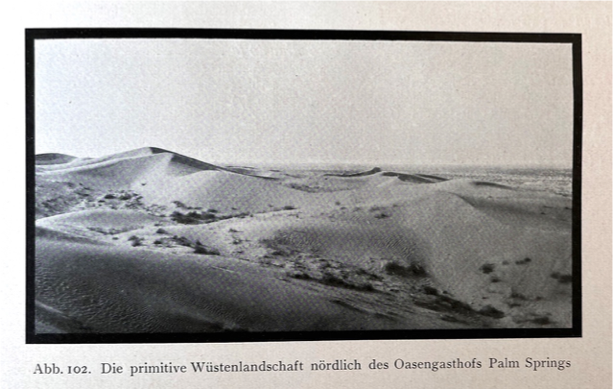
While the Miller House pays homage to its desert roots, the Kaufmann Desert House, 1946, does not. The very last image in Wie Baut Amerika is shocking: no buildings, no big pieces of float glass, no steel, just ribbons of sand melting into the horizon. The caption reads, “Die primitive Wüstenlandschaft …”
That last word is often translated as “desert,” but the word is much deeper etymologically. It conveys barrenness, wasteland, a place so wild as to be inhumane.[10] His use of the phrase is telling: for all the deserved fame of the Kaufmann as one of the twentieth century’s seminal houses, the house conveys his own definition of “organic.” While he always acknowledged his debt to Wright, Neutra also pointedly distanced his differences with Wright’s “organic architecture” as the older architect defined in The Natural House, 1954. Neutra did not believe that “architecture was brought by the stork,” as he once said. “Any pretense that buildings are rooted, or draw nourishment from the ground or moisture from the soil … is poetic metaphor at best and misleading at worst,” he wrote.[11] The Desert House, he wrote with his typical attention to the power of language, was “inserted” into this harsh backdrop, “set on footings,” whose juxtaposition of artifice and artificial climate underscored “the weather, the silver-white moonlight, and the starry sky.” By contrast, “organic” to Neutra meant something deeper; the absolute requirement to attend to the tenets of his guiding philosophy, “biorealism.” This mean considering the generic as well as the individual in every person. “The tenants of the earth are a product of nature, from which they cannot live apart, and must not live in opposition …” It meant that he intended to elevate the quality of life in (apparently) ineffable ways that were nonetheless acutely contrived: great residential architecture is, after all, the affordance of a unique set of opportunities on behalf of a client.
In this case, it was the wealthy, impatient, demanding Edgar J. Kaufmann, the department store magnate who expected nothing less than a world-class house for his winter sojourns.[12] Despite its the cool exterior and sense of proud reserve, this is a warm house, with planes of golden “Utah buff” stone woven through the many silver-painted aluminum and steel elements, with interior colors such as rose, green, canary yellow, and salmon, set against white and of course the infamous “Neutra Brown,” a dark brown that he used to make walls recede in good Gestalt fashion. The Kaufmann’s essential partei—the integration of vertical and horizontal planes, standard details pushed beyond the norm by high-end craftsmanship and choice materials, the living room’s famous full-height mitred glass corner opening to the pool with its radiantly heated walkways for chilly winter evenings—is a watershed in Neutra’s work. The metal louvers seen along the walkway to the guest quarters and again up on the “gloriette” (his ingenious response thwarting local regulations against second stories, resulting in an exquisite “shelter”) were his agile response to those harsh desert winds.[13]
Neutra’s pinwheel plan might seem a perverse choice for the desert, the very opposite of the low, massed, energy-conserving pueblo dwelling he noted in Wie Baut Amerika, but the dictates of the plan speak to more formal agendas. The pinwheel emphasizes both the extremes in social privacy here as well as a deep interlocking with the outdoors. The arms of the pinwheel throw intimates and others to the far ends of the plan: master and mistress, servants, children, and guests could not be farther apart. One wonderful pencil drawing of the plan shows those winds from the northwest (the same winds that rustled Schindler’s palm fronds at the Toole House) as a host of 45-degree diagonal lines while the four-part pinwheel, equipped with those metal louvers, oppose them. The drawing also conveys the feeling that the pinwheel might start spinning at any moment, like a child’s toy.
And by contrast to the Lovell Health House, Los Angeles, 1929, where the glass windows of Philip and Leah Lovell’s master bedroom face south and west with a shallow overhang on the south, meaning a possibly brutal afternoon and evening of solar gain, Edgar and Lillian’s bedroom face due east, looking and to morning light, a cave-like setting because of the protecting deep overhang.
Neutra populated both Palm Springs settings with careful transitions between house and die Wüste. At the Miller House, a border of jagged, flat Salton Sea stones defined the boundary between the irrigated patch of grass lawn (sown with seeds “imported” from St. Louis) and the untamed desert beyond.[14] The border both melds and divides one from the other, die Wüste to suburban domesticity, acknowledging a frisson, a tension. At the Kaufmann Desert House, the landscape, too, is humanmade: perfectly sized and placed boulders cascade down a sloping carpet of green lawn, the palm trees … all artifice.
To remind us all: all design is artifice to one degree or another. Neutra, the urbane Jewish intellectual, chose to emphasize that his Palm Springs projects were foreign objects. Schindler did not.
Frey
Albert Frey is so widely beloved by scholars as well as citizens of Palm Springs that it would be hubris to present something portending to be original. This, then, is a more personal recasting of what we know of Frey’s own response to the desert, yet again profoundly different than either Schindler’s or Neutra’s. I will concentrate on one major, if obvious, change as well as how his genius was reflected in his little-known primer, In Search of a Living Architecture, 1939.
Frey was not an idealogue. Rather, he radiated a refreshing attitude about architecture and life, quietly and firmly. There is something ineffably happy about his work, reflecting expertise in service of a curiosity unfettered by polemics. This is a man who told me he tested the joists for his first house, Frey I, by hanging from them … which is not to suggest he experimented ad-hoc. Frey’s early training reveals so much about him: as a teenager, he was building canoes of wood and canvas and appropriated his mother’s old gloves to build bellows for a camera he invented.[15] His university curriculum in Zurich was oriented to technics, not design, but as Frey scholar Joseph Rosa has noted, Frey quickly immersed himself in new thinking: the Bauhaus, Mies Van der Rohe, and DeStijl.
When I learned that Albert’s coworker in Le Corbusier’s atelier included early Modernist greats such as José Luis Sert, Charlotte Perriand, and Kunio Maekawa,[16] and that Frey worked on the Centrosoyuz in Moscow (that I had visited years before, walking miles through depressing Soviet buildiings) and yet somehow landed in Palm Springs, I was incredulous—like many others before me, I know. I was then in graduate school, and formulating my M.Arch. thesis, four housing units employing prefabricated steel components manufactured by a company serving agricultural applications. Somehow Albert agreed to be an informal advisor; I wound up with a fine scheme, beautiful models, and the opportunity to write about him.
Frey arrived in Palm Springs in late October 1934 to oversee the construction of the Kocher-Samson Building, having visited LA to see the work of Neutra, Schindler, and others in 1932. The building, as well as the Guthrie House that soon followed in 1935, was very much International Style, meaning creating shade through deep recesses punched into boxy white volumes, a series of solids and voids, rather than thin overhangs extended beyond the walls.[17] In later projects this changed after he and architect John Porter Clark, his partner from 1939 to 1957, mounted a 10-foot pole at the center of a circle, like a sun dial, to resolve the depth of overhangs at different sun exposures. At Frey II, his tiny glass and steel 800-square-foot jewel box cradled into a pink cinder block frame on the rocky slopes of Mount San Jacinto, Albert worked on the problem for a year.[18] He sited his second home north-south to provide for passive solar on the concrete floor in winter on the southern exposure and used less glass on the northern facade in summer. The massive boulder straddling indoors and out seems to hover momentarily, as though undecided whether to continue enroute, crashing through the glass to the city below. Flamboyant, of course, but this rock has other important work as well. Its elephantine mass radiates warmth on cold winter nights; spatially, it distinguishes bedroom from living space. Cross-ventilation cooled the house. The exterior materials of steel columns and powder-coated aluminum siding stood up to the harsh desert climate. Here in this harsh, seesaw climate, Frey’s love of the lean, resilience of metal and distrust of wood, plaster, and composite roofs made so much sense.
I first met Albert first in 1990, in Frey II, high above the city, quite separate from any drama below. He aligned his “house” (the word is so laden with stereotypes and seems wrong here) with the city’s grid and with the City Hall he had designed in 1952. My first question was, “Why here?” The tall man with the pale yellow short-sleeved shirt looked down at me with a courtly, patient expression. “Why, because architecture is about light and shadow, and the desert is all about light and shadow,” he exclaimed, as though surprised that an architecture student should ask such a question. “Switzerland was boring,” he added encouragingly. I asked him about the blue corrugated ceiling: “Why, It’s because of the Renaissance. You see all these blue ceilings in the Renaissance, their white clouds, the angels … I did not want the bright aluminum, which could be disturbing.”[19]
I was taken aback. In two sentences he shattered my naivete about what a stern canonical Modernist should be or should love.
He pickled the Philippine mahogany woodwork white with a Cabot stain (the Boston manufacturer the Greene brothers used for their Craftsman masterpieces decades earlier) because of his concern for the eye’s physical comfort. “The iris should not be shocked when it moves from the bright desert sun to the interior of the house.”[20] He loved yellow and blue, I learned, and many other colors as well, such as a sage green … all colors of the desert flowers. The copper brown of the slanted Cor-ten roof exactly matches the dark “desert burn” of the rocks lying on the mountainside. Even Frey’s wardrobe “demonstrated a sensual notion of esthetic frugality. He wore shirts, trousers, and socks in a strictly limited palette of white, powder blue, salmon, pale yellow, and beige.”[21] (Frey had always been a bit of a clothes horse. In his ‘20s he wore outfits more likely seen on golf courses: plus fours (baggy knickers), long Argyle socks, and an oversize baseball cap, often angled jauntily.
Recounted many times and not here, his extraordinary repertoire demonstrates two things: his genius and agility in responding to all design questions a priori, without presumption; and being anchored in the promise and love of industrial materials to deliver humanistic design without being their slaves.
The Aluminaire House, 1931, designed by Frey with A. Lawrence Kocher, is renowned as the country’s first all-metal house (Richard Neutra’s Lovell Health House, 1929, was the first steel-framed residence.) The former has become an iconic object exemplifying Modernism but it was always intended to be part of a low-cost housing project, much in the spirit of early Modernism’s earnest social ideals. As published in The Architectural Record, April 1931, the tract’s layout shows that house as one of many identical homes, here staggered and rotated, providing privacy amidst gardens and trees distributed throughout the tract.
Frey realized this idea of animating a tract in his 15-unit Bel Vista tract, 1946, in northern Palm Springs … and if most of what we know of Frey is the astonishing Frey II, it’s hard to recognize these as Albert’s work. No dazzling steel, aluminum, and canvas, no Corbusian piloti, no Renaissance blue corrugated ceilings. Frey II, after all, was his private refuge, for him and for the quail he fed every morning before his solitary hike at dawn.
Bel Vista was constructed to be affordable for World War II workers. The flat-roofed, 1,120-square-foot modest structures sit firmly on the ground, built with standard wood framing and stucco. Asymmetric overhangs shelter shallow recessed and projecting portions of these essentially square houses in this regard very much like Schindler’s square Popenoe Cabin with its wandering overhangs and porches. Bel Vista’s interiors are telling: a hallway wrapping the central mechanical and storage core allows ready access to any part of the house. In this small house, seven doors provide access to the outdoors. That’s a lot, an extraordinary luxury for “basic” houses. It’s a choice that speaks to Albert’s belief that everyone needed to be connected to nature and to determine their own path of travel. Outside, in one home sections of the original corrugated fencing, sage green, still remain. This familiar Frey trademark is perhaps the only obvious link to him[22] unless one knows about his love of contrast in shapes: one door leads to the outdoor laundry line, hidden from view by a semi-circular wall of basket-weave brick, a curve alive amidst all the hard right angles.
Frey designed that theory of contrasts into the hardscape and second storey of Frey I, which started out as a 320-square-foot house in 1941 and enlarged in 1947 and 1957. The swimming pool was lassoed by a sweeping, curvilinear screen wall of corrugated metal and fiberglass sheathing in overlapping panels of red and yellow, resulting in a patchwork quilt of color red and yellow.
But curves had other functions apart from aesthetically animating a project. As he explained,
“Because of the contour of the curve, the wall is self-supporting. That was a wonderful thing. I have a few struts, three-quarter inch pipes, but that’s all. So I get a wall that’s less than a sixteenth of an inch thick and it supports itself! That’s what I’m after, you see, to preserve material, to use the least possible amount. There should always be economy in cost … Economy is always important because if people can’t afford it, it’s not a solution.[23]
In its return to the ground plane, Bel Vista exemplifies Frey’s ability to adapt to the desert and to the needs of a varied clientele, just as the Kocher-Samson Office Building does.
Frey celebrated contrasts in his primer, In Search of a Living Architecture. Each two-page spread is a short lesson in architecture. On the left is a photograph, anything from a natural feature or a brute industrial construction or a scattered collection of huge water tanks against the backdrop of a mountain range, to Mont St. Michel; to a pueblo, to even a dirigible and a cantilevered diving board. On the opposite page, is a Modern response to those patterns, rhythms, materials, and forms that acquits a human in new ways and exploits new materials. His examples range from Giuseppe Terragni’s brilliant Casa del Fascio, Como, Italy, 1936 to Neutra’s VDL Research House, Los Angeles, 1932. What captured my attention, however, is a third, quite small, figure on the spread: Frey’s distillation of the parti into a simple diagram that bridges the two images. He discusses the psychological and emotional implications of forms, open and closed, curved and straight, tall and short, old and new. The book invites, never coerces, an understanding of the promise of Modernism.
Influence
In the 1990s, a popular saying among some faculty and students at Sci-Arc (Southern California Institute of Architecture) went something like this: “Plagiarism is inevitable, progress implies it,” meaning that influences are all around us, and that the best architects do not copy but interpret, build on, and respond to specific sites, new contexts and cultures.[24] After all, architecture is physically present. It takes up space and unless demolished, is present, in one’s path. As the Victorian architect Edward Lacy Garbett wrote in 1850, a building is
“ … a necessary evil: it shuts out from us air and light, and the view of beauteous Nature; it encumbers a portion of the earth’s surface and encloses a portion of the free atmosphere. It has no right to do so, without making or attempting what compensation it may for these injuries.[25]
While this essay doesn’t trace the nature of such influences or claim that linear relationships exist at all, a few observations do come to mind. For example, the important role of roofs and deep overhangs in the desert: the sun bearing down without recompense requires a response.
One might expect that Schindler would have visited Taliesin West (Taliesin III), Scottsdale, 1937, with its low rock walls, angles, and its intense relationship with the desert landscape, qualities not dissimilar to Schindler’s intimate response to the desert in the Toole House. Architect, engineer, and inventor Walter S. White (1917 – 2002) worked for Schindler for 18 months, 1937-38, and for Clark and Frey between 1947 and ‘48, both offices where curiosity and experimentation were the default setting. White’s roofs, hyperparabolic (spectacularly exuberant at the Willcockson House, Indio, 1959); or voluptuously curved (as seen at the now restored Miles Bates House, 1953) precede Frey’s Tramway Station, 1964. Frey’s center pivoting windows for Frey I, 1935, might have inspired White’s own center-pivoting “Solar Heat Exchanger Window Wall,” patented in 1975. William Krisel (1924 – 2017), another of the City’s famous sons, acknowledged Le Corbusier’s 1930 unbuilt scheme for a Chilean heiress as Krisel’s inspiration for his own butterfly roof, the shape that Krisel made famous in his fab tract we know and love today as Twin Palms.[26] In his beach front development, the 12-unit El Pueblo Ribera, La Jolla, 1923, Schindler took one standard unit and rotated and flipped it so that each unit enjoys a unique, and private, relationship to views and to gardens, just as Frey did at Bel Vista in 1946 and Krisel did at Twin Palms a decade later. Arriving to visit Neutra (without his portfolio) after graduating from the University of Minnesota and landing a job that afternoon, Don Wexler, Palm Spring’s king of residential steel, worked for Neutra in 1951 before departing for Palm Springs in 1952. He would have known about, and doubtless visited and admired, Neutra’s steel-framed Lovell Health House. Neutra, in turn, worked on commercial steel-framed skyscrapers in Chicago, providing some degree of confidence when electing to build the outrageous Lovell Health House.)
And so it goes. Schindler, Neutra, and Frey, encountered the desert. Each responded on their own terms, and thus we celebrate each on its own terms.
[1] Marco De Michelis, “Rudolf M. Schindler: The Invention of an American Tradition”, Canadian Centre for Architecture website, http://www2.cca.qc.ca/pages/Niveau3.asp?page=mellon_demichelis&lang=fra. De Michelis quotes Schindler’s article “‘Care of the Body’: Shelter or Playground”, Los Angeles Times, 2 May 1926. Reprinted in August Sarnitz, R.M. Schindler Architect (New York: Rizzoli, 1988), 46-47.
[2] The author wishes to acknowledge and thank scholar Luke Leuschner, who was exceptionally generous in sharing his research with me. His own forthcoming book will thoroughly explore Schindler’s work in the Coachella Valley.
[3] Paul Popenoe (1888 – 1979) was initially a respected agricultural expert who cultivated exotic date species and added to the family’s business founded by his father, Frederick Popenoe, a pioneer of the avocado industry. Paul Popenoe became known in later decades as a eugenicist intent on the segregation of “waste humanity.” Still later, he became nationally famous as a marriage counselor, establishing the iconic “Can This Marriage Be Saved?” column in the Ladies Home Journal, launched in 1953 and continuing well into the 2000s. The “absolutely essential” limit of $2,000 is part of a May 5, 1922, letter from Popenoe to Schindler, R.M. Schindler Papers, op. cit.
[4] In effect, Raumplan resembled Frank Lloyd Wright’s use of compression and expansion, i.e., entering a space with a low or dark ceiling and walking into a taller, light-filled space.
[5] Established in 1927 when Neutra and Schindler entered the competition for the League of Nations and ending three years later, the AGIC was a loose partnership that included the distinguished housing authority and urban planner Dr. Carol Aronovici (1881 – 1957), a Romanian immigrant. While few of the estimated 30 projects designed by the firm, it was also responsible for the famed Jardinette Apartments, largely Neutra’s work but employing Schindler’s structural engineering talents and his skill with reinforced concrete, and now being restored.
[6] Michael Darling, “The Vulnerable Architecture of R.M. Schindler,” in The Architecture of R.M. Schindler, org. by Elizabeth A.T. Smith and Michael Darling (Los Angeles: Museum of Contemporary Art with Harry N. Abrams, 2001), 204.
[7] Ibid.
[8] James Hill, “Modernizing 1921: Schindler Camps Out,” https://talkingbuildings.com/modernizing-1921-schindler-camps-out/, retrieved Feb. 25, 2023. Hill quotes Schindler in “A Co-operative Dwelling,” in T-Square, February 1932.
[9] These are possibly snapshots that Rudolf Schindler took on his 1915 road trip through the Southwest. In 1926, the Neutras, Richard and Dione, were still living at Schindler’s Kings Road House. The Neutras came directly via train from their time with Frank Lloyd Wright’s home and practice, Taliesin at Spring Green, Wisconsin, in February 1925, stopping for a few hours at the Grand Canyon; apart from that, it is doubtful that the Neutras visited the Southwest as Schindler had.
[10] Neutra also dramatically called the Coachella Valley the “Badlands of the Cordillera,” badlands a term for inhospitable and rough geography torn up by pinnacles and gullies.
[11] Barbara Lamprecht, Richard Neutra – Complete Works. (Kologne, Los Angeles: Taschen, 2000). p. 52. Quote is from unpublished, undated manuscript, “Architecture and the Landscape,” UCLA Special Collections, Charles E. Young Library, Richard Joseph Neutra Papers, Manuscript Collection 1179.
[12] Kaufmann, of course, was accustomed to the best, hiring Frank Lloyd Wright for Falling Water, Bears Run, Pennsylvania, 1935.
[13] In his 2021 essay “Neutra and Brazil,” Raymond Neutra, Richard and Dione’s youngest son, writes that Neutra “visited the Los Eucalypos apartment house designed by Jorge Ferrari Hardoy and Kurchan in 1941, where he was introduced to the idea of vertical rotating louvers that in turn were designed by another architect Villalobos.”
[14] Stephen Leet, Richard Neutra’s Miller House, New York: Princeton Architectural Press, 2004, 126. See also “The Landscaping Cannot Come Later: Richard Neutra’s Faith in Landscape,” Barbara Lamprecht, Eden Magazine, Fall 2020, Vol. 23, No. 4, 4 – 29.
[15] Joseph Rosa, Albert Frey, Architect, New York: Rizzoli, 1990), 12-15.
[16] Kunio Maekawa (1905 – 1986) was one of Japan’s greatest architects. After attending a lecture in Japan given by Richard Neutra, who was on a round-the-world lecture tour, Maekawa wrote him an impassioned letter on June 12, 1930, thanking Neutra for his belief in the power of architecture and in collaborative effort. Maekawa worked for Le Corbusier in the late 1920s and then, returning to Japan in 1930, worked with Antonin Raymond, a student of Frank Lloyd Wright, for five years.
[17] Although appearing to be a standard wood-frame-and-stucco building, the Kocher-Samson’s construction is a progressive hybrid of concrete, metal decking, and lightweight steel frames, complete with a very unapologetic X-brace of two steel tie rods in the picture window facing the street.
[18] Email correspondence with Sidney Williams, former Curator of Architecture and Design, Palm Springs Art Museum, March 4, 2023. Ms. Williams noted Jennifer Golub’s Albert Frey Houses 1+2 (Princeton: Princeton Architectural Press, 1998, which includes the image of Frey’s sun device.
[19] Neil Jackson and Barbara Lamprecht, “Desert Pioneer,” The Architectural Review, Sept. 1992, 40 – 44.
[20] Ibid. Lamprecht quotes Albert from an interview conducted Oct. 3, 1991.
[21] Randy Garner, “Palm Springs Architect: Albert Frey,” Sept. 29, 2021, VisitPalmSprings, https://visitpalmsprings.com/palm-springs-architect-albert-frey/
[22] The author thanks historian and realtor Todd Hays, for access to his two Bel Vista homes. Hays authored a nomination to the first Bel Vista home he meticulously restored and is now completing his second.
[23] Op.cit., Jackson, Lamprecht
[24] The quote is attributed to French Marxist theorist, writer, and filmmaker Guy Debord (1931 – 1994.) The adage has also been attributed to Comte de Lautréamont (the nom de plume of Lucien Ducasse,1846 – 1870.)
[25] Edward Lacy Garbett, Rudimentary Treatise on the Principles of Design in Architecture as Deducible fromNature and Exemplified in the Works of the Greek and Gothic Architects (London: J. Weale, 1850), 6.Op.cit., Jackson, Lamprecht.
 Modern Resources
“Neutra, in turn, worked on commercial steel-framed skyscrapers in Chicago, an experience that girded him with the courage to build the Lovell Health House’
Masterful analysis, research and vocab!
LikeLike